
Invited Speakers
Sym1. Symposium: Molecular Imaging Meets Nanomedicine

Chair: Prof. Kannie WY Chan
City University of Hong Kong
Sym 1.4 – Advanced CEST MRI for Imaging Drug Delivery and Therapeutic Efficacy

Prof. Peter Barker
Johns Hopkins University
Keynote 1 – Recent Developments in Metabolic Imaging of the Human Brain

Prof. Yi Wang
Cornell University
Keynote 2

Prof. Guanshu Liu
Johns Hopkins University
Sym 1.1 – Development of a Multimodal Imaging Platform for Trackable Therapeutic EVs

Prof. Jiadi Xu
Johns Hopkins University
Sym 1.2 – Moving Spins in the Brain: Exploring Chemical Exchange and Water Flow with MRI

Nalinikanth Kotagiri
University of Cincinnati
Sym 1.3 – PET-based Theranostics with Engineered Bacteria and OMVs
IS T1. Nano/Microscale Biomaterials and Biosystems for Stem Cell Engineering and Mechanobiology

Chair: Prof. Yubing Sun
University of Massachusetts Amherst
IS T1.5 – Profound Gap Closures Driven by Tissue Growth and Fluidization

Chair: Prof. Shue Wang
The University of New Haven
IS T1.2 – Engineering Bone-derived Nanoparticles of Mesenchymal Stem Cells Osteogenesis

Prof. Donny Hanjaya-Putra
University of Notre Dame
IS T1.1 – Tailoring Biomaterials to Guide Organoids Structure and Function

Prof. Yuguo Lei
The Pennsylvania State University
IS T1.3 – Dissolvable Microbioreactors for Large-scale Cell and Virus Production

Prof. Hongyan Yuan
Southern University of Science and Technology
IS T1.4 – Unilateral Wall Constraints Induce Edge Entrapment in Migrating Cells: A Mechanistic Study
IS T2. Next-Gen Diagnosis and Health Monitoring

Chair:
Prof. Li Hui
Southern Illinois University
IS T2.1 – Accelerating Pathogen Diagnosis Through AI-Enhanced Single-Cell Detection

Kuangwen Hsieh
Johns Hopkins University
IS T2.2 – Catch, Move, Detect: Immuno-Magnetofluidic HIV Self-Test from Fingerstick Blood

Prof. Wei Ouyang
Dartmouth College
IS T2.3 – Bioresorbable Electronics for Monitoring Organ Health

Prof. Peng Shi
South China University of Technology
IS T2.4 – Fluorescent DNA-Polymer Enables Signal Amplification in Expansion Microscopy

Prof. Yongliang Yang
Shenyang Institute of Automation, University of Chinese Academy of Sciences
IS T2.5 – SARS-CoV-2 Spike Glycoprotein and ACE2 Interaction on Cell Membrane during Infection
IS T3. Microenvironment s and Mechanistic Models in Cancer, Infection, and Regeneration

Chair: Prof. Ninghao Zhu
Kansas State University
IS T3.1 – Probing Collective Cancer Invasion in a Tissue-Engineered Blood–Tumor Barrier Model

Prof. Yang Song
Sichuan University
IS T3.2 – Curvature Matrix Spatial-Temporally Primes Epigenetic State for Enhanced Cell Reprogramming Efficiency

Prof. Guangfu Wu
Tongji University
IS T3.3 – Wireless, Battery-Free Push-Pull Microsystem for Membrane-Free Neurochemical Sampling in Freely Moving Animals

Prof. Yu-Jui Fan
National Yang Ming Chiao Tung University
IS T3.4 – Development of Thrombosis-on-a-chip Based on Light-induced Cell Inflammation

Prof. Kun Zhao
University of Electronic Science and Technology of China
IS T3.5 – The Role of Sucrose-Dependent Exopolysaccharides in Streptococcus mutans Biofilms Revealed at Microscale Level
IS T4. Micro- /Nanoscale Technologies for Engineering and Imaging of Living Systems – I

Chair:
Prof. Kyoung-Je Jang
Gyeongsang National University
IS T4.1 – Fabrication Strategies of Bioderived Nanomaterials for Tissue Engineering and Protein Delivery

Chair:
Prof. Jangho Kim
Chonnam National University
IS T4.5 – Ultra-tiny Scale Biomimetic Approaches for Regulation of Cell Function and Tissue Regeneration

Prof. Sung Yun Hann
Kyungpook National University
IS T4.2 – Adaptive 3D/4D Bioprinting of Vascularized Tissues for Regenerative Nanomedicine

Prof. Geonwoo Kim
Gyeongsang National University
IS T4.3 – The Classification of Metastatic Spine Cancer and Spinal Compression Fractures by Using CNN and SVM Techniques

Prof. Hoon Seonwoo
Sunchon National University
IS T4.4 – Application of Natural Resources as 3D Bioprinting Biomaterials
IS T5. Biosensing and Biomedical Microtechnologies

Chair: Prof. Kin Fong Lei
Chang Gung University
IS T5.5 – Investigation of Cellular Crosstalk using a Vascularized Bone-on-Paper Platform

Prof. Yuanyuan Guo
Tohoku University
IS T5.1 – Thermally Drawn Multifunctional Fibers for Neurochemical Sensing and Biofluidic Interfaces

Prof. Zong-Hong Lin
National Taiwan University
IS T5.2 – Advances in Self-Powered Sensing: Triboelectric Nanosensors for Selective and Versatile Detection

Prof. Hui Yu
Shanghai Jiao Tong University
IS T5.3 – Next-generation Digital Biosensors for Low-abundance Biomarker Detection

Prof. Yen-Heng Lin
Chang Gung University
IS T5.4 – Ultrafast PCR/qPCR Microfluidic Platform
IS T6. Wearable Biomedical Devices for Healthcare

Chair:
Prof. Yu Song
City Universtiy of Hong Kong
IS T6.6 – Wearable Bioelectronics for Personalized Healthcare

Prof. Ji-Hwan Ha
Hanbat National University
IS T6.1 – Nanotransfer Printing of Metal Nanopatterns on Electrospun Fibers for Diagnostic Applications

Prof. Junseong Ahn
Korea University
IS T6.2 – All-inorganic Nanoribbon Yarns for Wearable Transducers

Prof. Yongrok Jeong
Kyungpook National University
IS T6.3 – Microstructure-based Pressure Sensors for Biomedical Devices

Prof. Jiajie Chen
Shenzhen University
IS T6.4 – Optothermal Nanotweezers:Nanomaterials manipulation and Single-Molecule Biosensing

Prof. Yuye Wang
Shenzhen University
IS T6.5 – Optical Phase–Driven Plasmonic Biosensing Platform for Ultrasensitive and Multiplexed microRNA Detection
IS W1. Bio/NanoSensing

Chair: Prof. Minghui Wu
Nanjing Agricultural University
IS W1.2 – Rapid Detection of Zoonotic Diseases Based on Visual Microfluidic Chip

Prof. Xiaojiang Xie
Hong Kong University of Science and Technology
IS W1.1 – Ionophore-based Ion-Selective Chemical Sensors: From Electrodes to Nanoparticles

Prof. Gaobo Wang
Xinxiang Medical University
IS W1.3 – Micro/Nano Biomedical Devices for Precision Diagnosis and Therapy

Prof. Li Wang
Nanjing Tech University
IS W1.4 – Biomimetic Ionic Synaptic Devices Based on Heterogeneous Hydrogel Interfaces

Prof. Tianyi Jiang
Harbin Institute of Technology
IS W1.5 – AC-Electrokinetic Manipulation of Micro/Nanoparticles
IS W2. Smart Platforms for Real- Time Biosensing, Neuroengineering, and AI-Driven Diagnosis

Chair: Prof. Ninghao Zhu
Kansas State University
IS W2.1 – Real-Time Mapping Gene Expression Linked to Cognitive Decline in a Tissue-Engineered Brain Model for Alzheimer’s Disease
Yi Lu
Fasteur Inc.
IS W2.2 – AI-Powered Early Identification of Invasive Filamentous Fungi Using Dual-View Culture Plate Images
Prof. Guangfu Wu
Tongji University
IS W2.3 – Implantable Neural Interfaces for Brain Signal Detection and Modulation
Prof. Haoyang Chen
Shenzhen Institutes of Advanced Technology, Chinese Academy of Sciences
IS W2.4 – Combining Light and Sound Using Novel Transparent Ultrasound Transducers
IS W3. Microrobots and Microdiagnostic Systems

Chair: Prof. Yi Zhang
University of Electronic Science and Technology of China
IS W3.5 – 3D-Printed Multimodal Biomimetic Magnetic Soft Millirobots

Prof. Megan Yi-Ping Ho
The Chinese University of Hong Kong
IS W3.1 – Deformability Cytometry for Noninvasive High-throughput Characterization of Cells

Prof. Xing Ma
Harbin Institute of Technology
IS W3.2 – Biomedical Micro/Nano-motors

Prof. Chenjie XU
City University of Hong Kong
IS W3.3 – Development of Microneedle Devices with Anisotropic Porous Structure for Biomedical Application

Prof. Xuming Zhang
The Hong Kong Polytechnic University, X Beauty Technology Limited
IS W3.4 – NADew: Microfluidic Platform for Photoregeneration and Droplet Encapsulation of NADH for Anti-Aging Applications
IS W4. Microfluidics for Cell and Bio- Analysis

Chair:
Prof. Chia-Hung Chen
City University of Hong Kong
IS W4.5 – Microfluidic Living Surface-Anchored Immunosorbent Assay (LISA) for High-Throughput Single-Cell Analysis

Prof. Cheow Lih Feng
National University of Singapore
IS W4.1 – High-Throughput Screening of T Cell Epitopes Using Microfluidic DNA-Barcoded APC Libraries
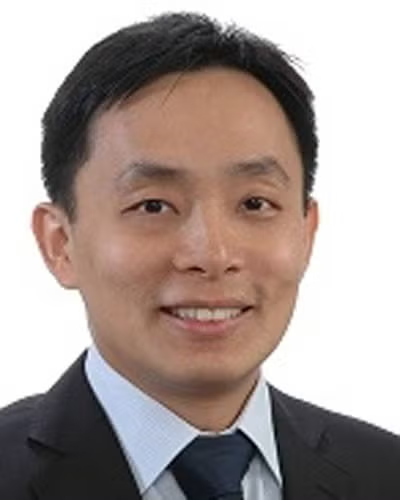
Prof. Hwa Liang Leo
National University of Singapore
IS W4.2 – Aligned, Conductive Fibrous Bio-inks for Cardiac Patch Tissue Engineering Applications

Prof. Hsing-Ying Lin
National Tsing Hua University
IS W4.3 – Integration of An Economical Digital Droplet Microfluidic Chip, Portable Optical Sensing Device, and Smartphone-based Intelligent Edge Computing for Sensitive Detection and Absolute Quantification of Marker Genes

Prof. Jin Zhang
Western University
IS W4.4 – Transport of Carbon Quantum Dots Across Bovine Blood Retina Barrier
IS W5. Smart Biomaterials for Therapeutic Advances

Chair: Prof. Ting-hsuan Chen
Department of Biomedical Engineering, City University of Hong Kong

Prof. Chao Liu
Southern University of Science and Technology
IS W5.1 – Harnessing Macrophage Mechanobiology: New Therapeutic Strategies for Bone Regeneration

Prof. Youhua Tan
Hong Kong Polytechnic University
IS W5.2 – Mechanical Regulation of Cancer Progression

Prof. Kwan T CHOW
City Universtiy of Hong Kong
IS W5.3 – Leveraging Nanomedicine for Immune-Enhanced Treatment of Cancer and Infections

Prof. Jiashing Yu
National Taiwan University
IS W5.4 – NIR-activated Organic Molecule-based Nanocomposites with Photothermal and Photodynamic Effects for Cancer Treatment

Prof. Weiping Wang
The University of Hong Kong
IS W5.5 – Photoresponsive Nanomedicine for Cancer and Eye Diseases
IS W6. Biosensors for Rapid Diagnostics

Chair: Prof. Zhugen Yang
Cranfield University
IS W6.4 – Low-Cost Biosensors for Point-of-Care Diagnostics

Dr. Lin SU
Queen Mary University of London
IS W6.1 – Engineering Electron Transfer for Rapid, Living Biosensors

Prof. Xing Xie
Georgia Institute of Technology
IS W6.2 – Application of Porous Super-absorbent (PSAP) Beads for Liquid Purification and Preservation

Prof. Zeynep Altintas
Kiel University
IS W6.3 – Microneedle-Based Sensor System for Intelligent Chronic Wound Management
IS W7. Bioimaging: Technology and Applications

Chair: Prof. Qinrong Zhang
Department of Biomedical Engineering, City University of Hong Kong

Prof. Junle Qu
Shenzhen University
IS W7.1 – Advancing Confocal Super-Resolution Imaging: from STED to FSTM, FIRED and Beyond

Prof. Kevin Tsia
The Hong Kong University
IS W7.2 – Ultra-fast Optical Microscopy

Prof. Wei Chen
Huazhong University of Science and Technology
IS W7.3 – High-throughput Volumetric Mapping of Synaptic Transmission and Microcirculations in the Brain

Prof. Puxiang Lai
Polytechnic University of Hong Kong
IS W7.4 – Dual-Color Upconversion Adaptive Optics Microscopy: Simultaneous Deep-Penetration Wavefront Sensing and Sub-500-nm Imaging

Prof. Tymish Y.Ohulchanskyy
Shenzhen University
IS W7.5 – Multimodal Imaging and Near Infrared Optical Microscopy to Monitor Biodistribution of Nanophotosensitizers and Locally Induce and Evaluate the Photodynamic Action
IS W8. Nanobio and Nanomed Platform for Tissue Engineering and Cell Analysis

Chair:
Prof. Hyunho Lee
Myongji University
IS W8.3 – Inductive PCR Platform for Genetic Analysis of C. Elegans Cell

Prof. Masayoshi Tanaka
Institute of Science Tokyo
IS W8.1 – Sensing Curves, Growing Gold: Molecular Tools for Membrane and Nanoparticle Engineering

Prof. Su-Hwan Kim
Chung-Ang University
IS W8.2 – Metal-free PCET-active Nanozymes for ROS Regulation and Gasotransmitter Generation

Prof. Kyobum Kim
Dongguk University
IS W8.4 – Biomaterial-mediated ex vivo Natural Killer Cell Surface Engineering: Augmented Anticancer Efficacy of Adoptive Cell Therapy

Prof. Sang Jin Lee
The University of Hong Kong
IS W8.5 – High-density Stem Cell-laden Transplantable 3D Hydrogels for Tissue-integrative in situ Therapy
IS W9. Advanced Microfluidics for Disease Prevention and Treatment
Chair: Prof. Ting-hsuan Chen
City University of Hong Kong

Prof. Hon Fai Chan
The Chinese University of Hong Kong
IS W9.1 – Bioactive Glass-based Strategies for Treating Soft Tissue Injury

Prof. Hui Yang
Shenzhen Institutes of Advanced Technology, Chinese Academy of Sciences
IS W9.2 – Microfluidics and Nanophotonics for Sample Manipulation and Biosensing

Prof. Bee Luan Khoo
City Universtiy of Hong Kong
IS W9.3 – Microfluidics-based Patient-derived Disease Detection Tool for Precision Medicine

Prof. Xiaohong Zhou
Tsing Hua University
IS W9.4 – A Covalent Bonding Peptide-resin Separation Method for Specific Enrichment of Infectious Viruses in Wastewater

Prof. Angela Wu
Hong Kong University of Science and Technology
IS W9.5 – Perfusable Vascularized Human Brain Organoids
IS W10. Multiscale Biomedical Technologies for Exploring Solutions to Neurodegenerative Diseases

Chair:
Prof. Hee-Gyeong Yi
Chonnam National University
IS W10.1 – Engineering Human Vessel Models with Bioprinting and Extracellular Matrix Bioinks

Prof. Xin Song
City University of Hong Kong
IS W10.2 – Smart Microsystems for Thrombus Management

Dong-Heon Ha
EDmicBio inc. Seoul
IS W10.3 – Organ-derived Bioinks and Advanced 3D Bioprinting Technologies for Enhanced Organ Fabrication and Commercial Translation

Prof. Jin-A Kim
The Korea University
IS W10.4 – Innervated Human Sensory and Motor Modules for Axis-Level Integration: A Multiscale Bio-Platform for the Sensory–Motor–Cognitive Axis

Prof. Jongmoon Jang
Yeungnam University
IS W10.5 – Next-Generation Cochlear Implants: Biodegradable Drug-Eluting Microscaffold Electrodes for Prolonged Multi-Drug Delivery
IS W11. Microscale Robotic for Healthcare Engineering

Chair: Prof. Jiachen Zhang
City Universtiy of Hong Kong
IS W11.4 – Small-scale Robots: Miniature but Capable Robots to Revolutionize Healthcare
Dr. Tieshan Zhang
Shenzhen University
IS W11.1 – Sub-millimeter Fiberscopic Robot with Integrated Maneuvering, Imaging, Biomedical Operation Abilities

Prof. Xiaoming Liu
Beijing Institute of Technology
IS W11.2 – Single Cell Operations by Micromanipulation and Microrobots

Prof. Hongri (Richard) Gu
Hong Kong University of Science and Technology
IS W11.3 – Scalable High-Throughput Microfluidic Separation of Magnetic Microparticles

Prof. Da-Jeng Yao
TECO Electric & Machiery Co., Ltd
IS W11.5 – Optimization of Engineering Processes Using the Complex-System-Response (CSR) Method
IS W12. Micro- /Nanoscale Technologies for Engineering and Imaging of Living Systems – II

Chair:
Prof. Sangbae Park
Seoul National University
IS W12.1 – Micro/Nanofabrication Technologies for Advanced Tissue Regeneration
Chair:
Dr. Sunho Park
Pusan National University
IS W12.2 – Nano/Microscale Technologies to Modulate Cellular Behaviors: from 2D to 3D Systems

Prof. Sang-woo Lee
Seoul National University
IS W12.3 – Nanotechnology-assisted Modulation of Salivary gland Protection and Regeneration
Woochan Kim
Chonnam National University
IS W12.4 – Multiscale Nanoengineered Hybrid Scaffolds for Enhancing Functional Cellular Activities in Tissue Engineering

Prof. Pik Kwan Peggy Lo
City Universtiy of Hong Kong
IS W12.5 – Precise Control of Light-Responsive Nucleic Acids for Biomedical Applications
Sym2. Symposium on Label-Free Imaging for Biomedical Applications

Chair:
Prof. Zhou Renjie
Chinese University of Hong Kong
Chair:
Prof. Yongliang Yang
Shenyang Institute of Automation, University of Chinese Academy of Sciences
Sym 2.7 – In Situ Characterizing Cellular Stiffness Using Quantitative Phase Imaging and Its Role in Collective Cell Migration

Prof. Tzu-Ming Liu
University of Macau
Sym 2.1 – Plasma Fluorochromics Diagnose Shift of Organ Metabolism

Prof. Minbiao Ji
Fudan University
Sym 2.2 – Rapid Histologic Imaging and Diagnosis with Stimulated Raman Scattering

Prof. Qi Gu
Institute of Zoology, Chinese Academy of Sciences
Sym 2.3 – Hierarchical Tissue Biofabrication and Functional Evaluation

Dr. Fan Yang
Shanghai Institute of Optics and Fine Mechanics, Chinese Academy of Sciences
Sym 2.4 – High-speed Stimulated Brillouin Scattering Microscopy for Biomechanical Imaging

Prof. Hui Qiao
Tsinghua University
Sym 2.5 – Computational Light-Field Imaging in Biomedicine
Prof. Hui Yu
Shanghai Jiao Tong University
Sym 2.6 – Plasmonic Microscopy
IS TH1. Emerging Technology for Biomedical Applications in Neural System

Chair: Prof. Chung Tin
City Universtiy of Hong Kong
IS TH1.4 – Cerebellum-targeted Transcranial Focused Ultrasound Stimulation Inhibits Hippocampal Epileptiform Activity

Prof. Hei Ming LAI
The Chinese University of Hong Kong
IS TH1.1 – Centimeter-scale, Single-cell Resolution, 3D Spatial Biology for Research and Clinical Use
Prof. Xudong LIN
Sun Yat-Sen University
IS TH1.2 – Ferromagnetic Electronics for Neural Engineering

Prof. Chen Liu
Xidian University
IS TH1.3 – Progress on Ultra-Flexible Transistor Devices and Packaging for Bioelectronics
IS TH2. The Next- Generation Biosensing

Chair:
Prof. Xiaotian Tan
Shenzhen Institutes of Advanced Technology

Prof. Xiaolu Zhu
Hohai University
IS TH2.2 – Cellular Mechanobiology in 3D Heterogeneous Cross-linking Hydrogels

Prof. Runhuai Yang
Anhui Medical University
IS TH2.3 – Medical Flexible Robots and Micro/Nano Sensing

Prof. Ting-hsuan Chen
City University of Hong Kong
IS TH2.4 – Quantitative At-home Rapid Tests Based on Microfluidic Particle Dam: Sample-to-Result on a Single Chip for Remote Healthcare
Important Dates:
Two-Page Abstract Deadlines:
August 1, 2025
Notification of Acceptance:
September 12, 2025
Full Paper Deadline:
October 3, 2025
(for best paper competition)
Early Bird Registration:
Before October 16, 2025
Late-News Abstract Submission:
November 3, 2025